
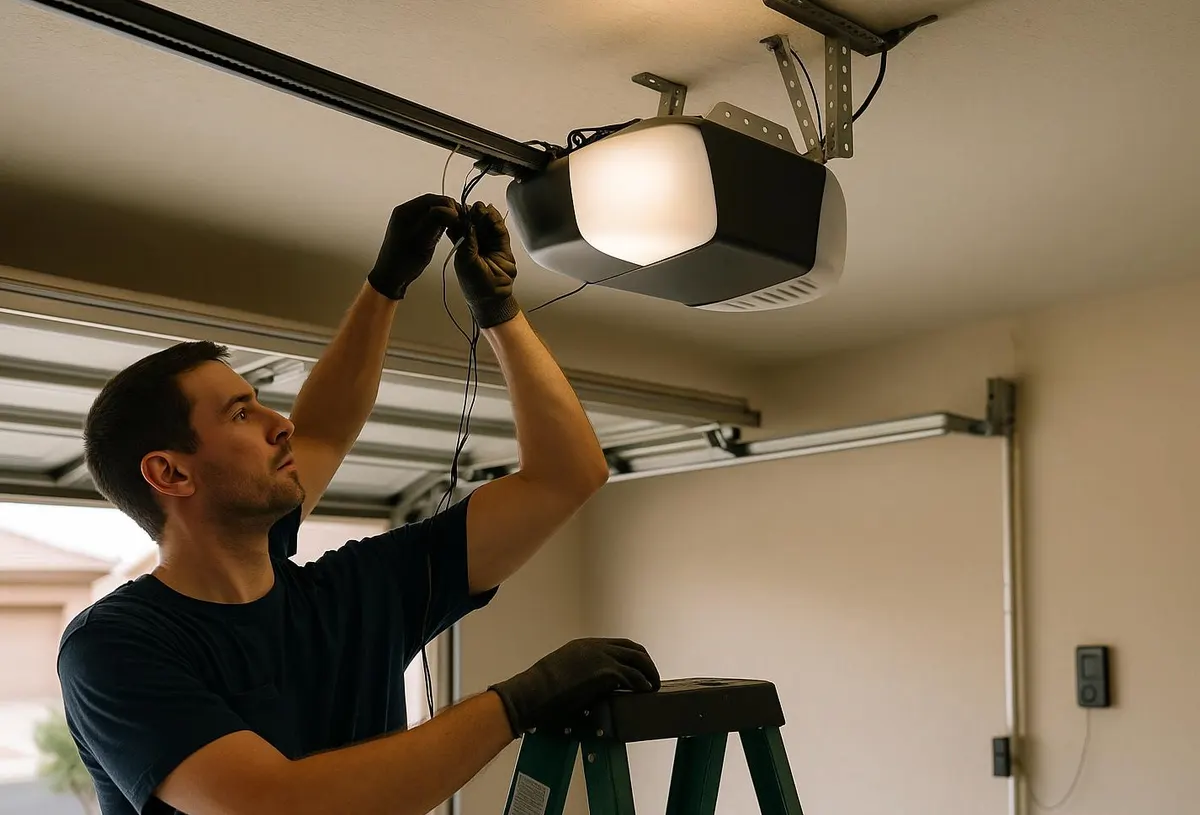
What a Technician Sees After the Wind Picks Up
A typical call during storm season starts the same way: a homeowner says the garage door 'blew in' or 'won't sit right' after a round of heavy wind and rain. On arrival, the panels are often bowed inward in the middle, a few rollers have popped clean out of the track, and the bottom corners are pulled away from the frame. Sometimes the opener's drive rail is bent because the door tried to buckle while it was still attached to the trolley. None of this happens because the door is old and tired — it happens because a wide, lightweight panel got hit with sustained pressure it was never braced to handle.
Why the Garage Door Is the Weakest Wall in the House
Every other wall on a house is a solid, continuous structure. The garage door is a large moving panel held in place by rollers in a track, a torsion spring system, and a handful of hinges — not studs and sheathing. When wind hits a closed garage door directly, that door has to resist the same pressure as a wall many times its thickness, using hardware that's designed mainly to lift and lower the door, not to fight a sustained horizontal load.
The real danger isn't just a wrecked door. If the door fails and wind gets into the garage, the pressure has nowhere to go but up and out, pushing on the roof structure from the inside. That's how a failed garage door turns into roof damage or even structural failure elsewhere in the house. In hurricane-prone parts of Florida, wind-load-rated doors and reinforcement exist specifically to keep that first failure from happening.
Signs Your Door Isn't Ready for a Real Blow
- Panels that flex or oil-can (a popping, bowing sound) when you push on them — a sign of thin material with no internal reinforcement.
- Worn or cracked rollers that have gone brittle or swollen from months of humidity; these are far more likely to jump the track under pressure.
- Stretched or fraying cables, which can snap suddenly when the door is under load, letting one side drop.
- No horizontal struts across the back of the panels — many older or builder-grade doors were never fitted with them.
- Rust at the track brackets or bottom bracket, especially on doors facing prevailing wind and salt-tinged air; rust weakens metal exactly where it needs to hold.
- A track that's slightly out of alignment, which gives the door less margin before it pops free under flexing.
Getting Ready Before the Next System Forms
Reinforce, Don't Just Hope
Retrofit bracing kits that bolt horizontal struts across each panel are one of the most cost-effective upgrades available, generally in the low hundreds of dollars installed. They stiffen the panel so wind pressure is spread across the whole door instead of concentrated in the middle, where bowing starts.
Replace Worn Rollers and Cables Before They're Tested by a Storm
Nylon rollers and steel cables both degrade with age, heat, and the swelling that comes from Florida's humidity swings. A roller that looks fine on a calm day can fail the moment it's pushed sideways by wind load. Replacing them as part of routine upkeep is far cheaper than an emergency call mid-storm.
Check Track Alignment and Lubrication
Afternoon downpours and heat cycles cause tracks to expand, contract, and occasionally shift on their mounting. A track even slightly out of true gives rollers less to grip when the door is flexing. Lubricating rollers, hinges, and the torsion spring keeps moving parts from binding or rusting, which matters more here than in drier climates.
Seal the Bottom and Sides Against Wind-Driven Rain
A worn bottom seal doesn't just let water in — it lets wind find a gap to push through. Fresh weatherstripping along the bottom and sides reduces both water intrusion and the air pressure that works against the door from inside the garage.
Test the Opener's Response
If the opener's auto-reverse or force settings are off, the door may not seat properly against the frame, leaving a gap wind can exploit. A quick test-and-adjust is worth doing before storm season peaks, not after.
When to Call Temple Terrace Overhead Door Co
If your door flexes noticeably, has worn rollers, or has never had reinforcement installed, that's a job for our Preventive Maintenance service — we inspect rollers, cables, tracks, and hardware, and recommend bracing where it's missing. If a storm has already bent a track, snapped a cable, or popped the door off its rollers, our Cable & Roller Replacement service gets it back on track and properly tensioned the same day in most cases.
Before the next storm system reaches Temple Terrace, give us a call to get your garage door inspected, reinforced, and ready to hold the line.